
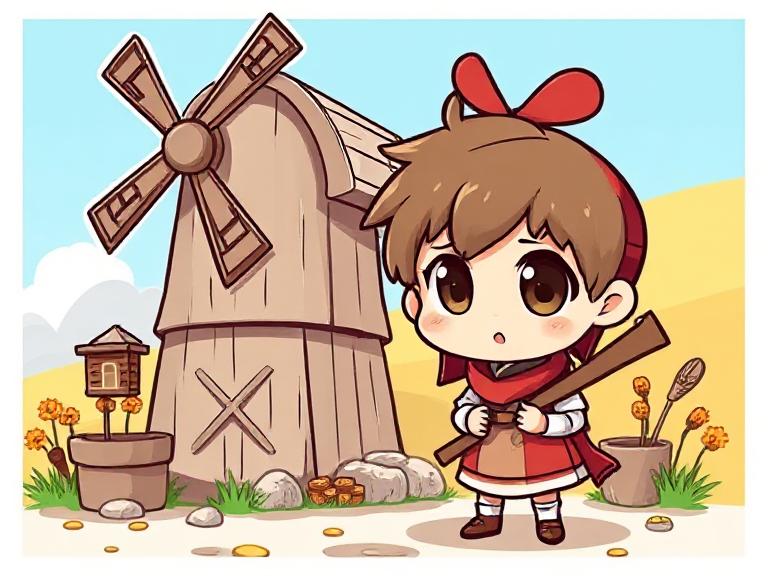
Once upon a time, there was and there was not, there was a miller living in olden times, amidst the sifting of grain and straw. The miller would first grind the wheat of those who came to the mill, and then he would bake **kömbe** (a type of flatbread/bread baked in ashes) from their flour. To avoid giving the kömbe back, he would engage in a lying contest with the owners and snatch the kömbe from their hands.
There was a father who had three sons. One day, the father gave his eldest son a sack ($teliz$ - a loosely woven bag made of linen or hemp) full of wheat. He asked his son to grind this wheat at the mill and bring it back. The eldest son went to the mill. The miller also entered into a lying contest with him. At the end of the day, he tricked the boy and took his flour from him. The eldest son returned home empty-handed.
The father this time sent his middle son to the mill. The miller tricked the middle son too and sent him home. The desperate father finally sent his youngest son to the mill. The boy arrived at the mill, and the miller first ground the youngest son's wheat into flour. Then, the miller said to the youngest boy:
"Let's bake *kömbe* with your flour and eat it. We'll eat some here, and you can take the rest home."
Since the youngest boy had come a long way, he was hungry. He liked the miller's offer. The miller and the young boy made a sack full of *kömbe* from the flour. After eating some of the *kömbe*, the miller said to the young boy:
"Friend, I have a proposition for you. Let's each tell a lie, and whoever's lie is bigger gets the *kömbe*."
The young boy wanted to teach the miller a lesson. Therefore, he accepted the miller's offer. The miller started the lie first. He pointed to one of the fields in front of the mill and said:
"Once upon a time, we used to sow watermelons in this field. The watermelons that came out of the field were so big, so enormous, that even a giant would have difficulty carrying just half of one watermelon."
When the miller's lie was finished, it was the young boy's turn. The young boy said:
"We had a bee. My grandfather used to plow the field with this bee. One day, the bee's neck got wounded. My grandfather crushed hazelnuts to make an ointment. He applied the ointment to the bee's wound. Suddenly, a hazelnut tree sprouted from the bee's neck. There were two hazelnuts on the tree. He cracked one open, and it was empty. Out of the second one came a piece of paper. The paper read, 'Don't bother, Miller, the *kömbe* belongs by right to the boy.'"
The miller was utterly stunned by what he heard; he couldn't decide whether to be upset about losing the *kömbe* or about meeting a more skillful liar than himself. While the miller was deep in thought, the young boy said to him:
"There will always be someone better than you. Don't be arrogant and think yourself above everyone else (at the legendary Mount Qaf). The ill-gotten gains you acquire through cunning, lies, and trickery will bring you no good. Since when did the property of the weeping bring joy to the one who laughs, that it should bring you any good? Do your work and speak your words truthfully, truthfully so that a truth-teller won't come along and put you in your place," he said, and he took his *kömbe* and went home.
From that day on, the miller repented his lying, never tricked anyone again, and lived a life earning an honest living.

Comments (0)
Please log in to comment
Log In